
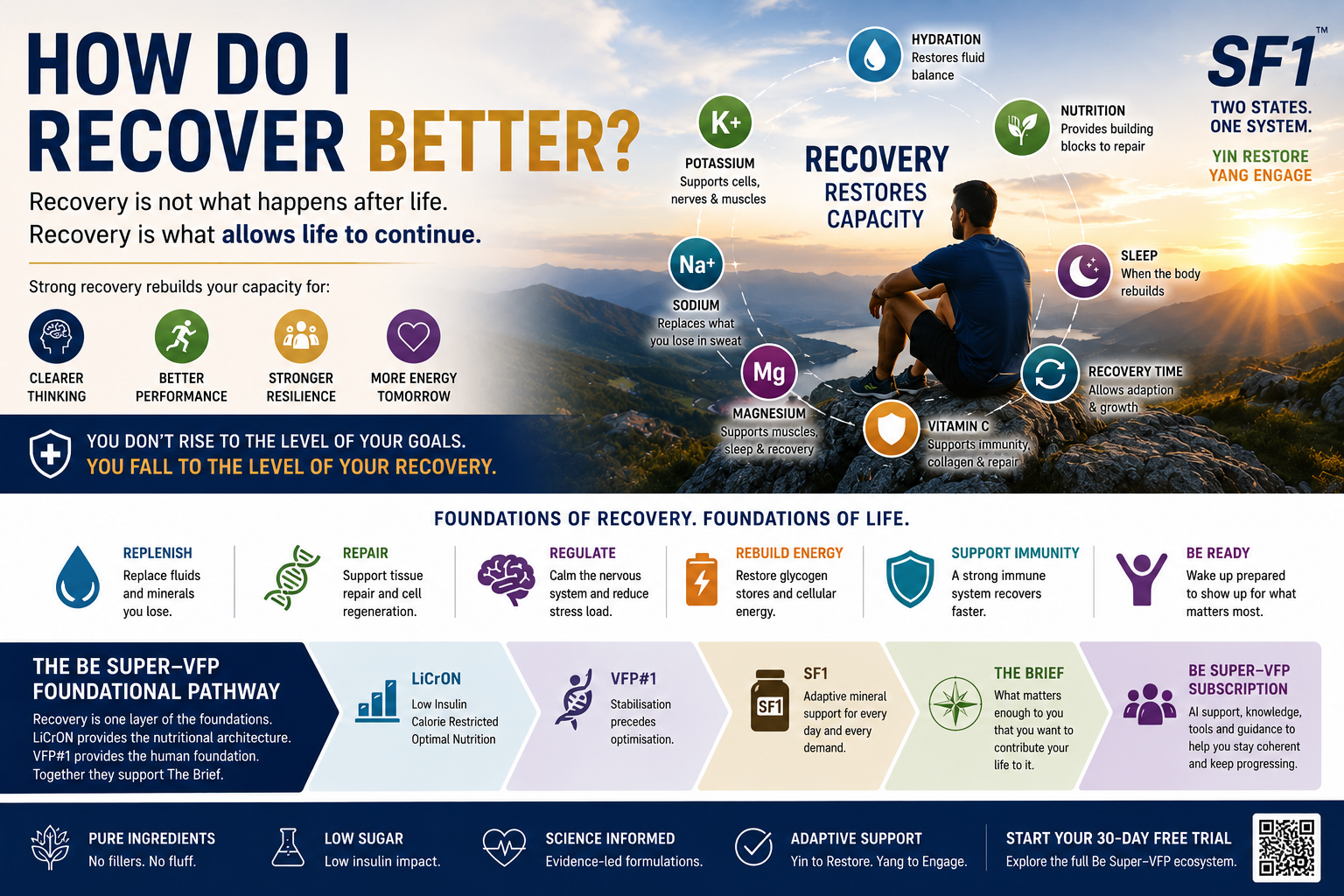
How Do I Recover Better?
Recovery Is Not Rest
Many people assume recovery simply means:
- stopping
- resting
- taking a break
- doing less
Rest matters.
But recovery is much bigger.
Recovery is the process through which the body restores capacity.
It is how we prepare for tomorrow.
Without recovery:
- performance declines
- clarity declines
- resilience declines
- participation declines
Recovery is not what happens after life.
Recovery is what allows life to continue.
Why Recovery Matters More Than Most People Realise
Everything we care about depends upon our ability to recover.
Work.
Family.
Training.
Relationships.
Learning.
Contribution.
Purpose.
The challenge is that modern life often asks for more output than recovery.
Many people spend years trying to improve performance whilst simultaneously reducing recovery.
Eventually the gap becomes noticeable.
What Happens During Recovery?
Recovery is not one process.
It is many processes occurring simultaneously.
The body is continually:
- repairing tissue
- restoring hydration
- replenishing minerals
- regulating hormones
- restoring nervous-system balance
- supporting immune function
- rebuilding energy reserves
Recovery is happening all the time.
Or at least it is trying to.
Why Hydration Influences Recovery
Every recovery process depends upon water.
But hydration is not simply water.
Hydration depends upon minerals.
This is why potassium and sodium remain so important.
Water follows minerals.
Cells function because minerals create the gradients that allow fluid movement and cellular communication.
Without sufficient hydration:
- recovery slows
- performance falls
- fatigue increases
This is one reason SF1 begins with mineral architecture.
The Potassium-Sodium Relationship
One of the most important relationships in the body is the potassium-sodium gradient.
The body generally requires significantly more potassium than sodium.
Potassium is concentrated inside cells.
Sodium is concentrated outside cells.
This relationship supports:
- nerve signalling
- muscle contraction
- cellular communication
- fluid balance
When the ratio becomes disrupted people may experience:
- fatigue
- weakness
- headaches
- brain fog
- muscle cramps
- reduced resilience
Why Sweat Changes Recovery
Many people think sweat is only water loss.
It is not.
Sweat contains minerals.
Particularly sodium.
The more someone:
- trains
- works physically
- spends time in heat
- exercises intensely
the more important mineral replacement becomes.
This is one reason SF1 Yang contains substantially more Himalayan Rock Salt than SF1 Yin.
Restore and Engage are different states.
Different states create different demands.
Why Magnesium Matters For Recovery
Magnesium is one of the most recovery-relevant minerals in the human body.
It contributes to:
- muscle function
- nervous-system regulation
- psychological function
- energy metabolism
- reduction of tiredness and fatigue
Low magnesium patterns may include:
- poor sleep
- muscle tightness
- irritability
- fatigue
- slower recovery
This is one reason SF1 uses Magnesium Taurate.
Recovery is not simply physical.
Recovery is also neurological and emotional.
Why Vitamin C Matters
SF1 uses Camu Camu as a whole-food source of naturally occurring Vitamin C.
Vitamin C contributes to:
- immune function
- collagen formation
- nervous-system function
- psychological function
- reduction of tiredness and fatigue
Recovery is not simply about muscles.
Recovery supports the whole person.
What LiCrON Teaches About Recovery
LiCrON stands for Low Insulin Calorie Restricted Optimal Nutrition.
LiCrON begins with a simple observation:
The body often recovers better when biological pressure is reduced.
Excessive blood sugar fluctuations.
Excessive insulin demand.
Poor nutritional quality.
Inconsistent eating patterns.
All can influence recovery.
LiCrON focuses on supporting:
- nutritional quality
- metabolic flexibility
- insulin stability
- biological efficiency
Recovery improves when the body has fewer obstacles to overcome.
What VFP#1 Teaches About Recovery
VFP#1 begins with a simple principle:
Stabilisation precedes optimisation.
Many people try to improve performance whilst neglecting:
- sleep
- hydration
- minerals
- nutrition
- rhythm
Yet these foundations influence every recovery process.
Before optimisation comes restoration.
Before performance comes preparation.
Before contribution comes capacity.
Why SF1 Exists
Most products focus on a single outcome.
Recovery.
Energy.
Performance.
Hydration.
SF1 was designed differently.
SF1 supports the foundations that influence all of them.
This is why it exists as two complementary states.
SF1 Yin — Restore
Supporting:
- recovery
- replenishment
- regulation
- preparation
SF1 Yang — Engage
Supporting:
- output
- sweat
- endurance
- contribution
One System.
Two States.
Why Recovery Matters To The Brief
Most people do not want recovery for its own sake.
They want recovery because something matters.
Someone matters.
A responsibility matters.
A future matters.
A contribution matters.
Recovery is not the destination.
Recovery supports participation.
Participation supports contribution.
Contribution supports The Brief.
The Brief
The Brief is simply:
What matters enough to you that you want to contribute your life to it?
Your health.
Your family.
Your work.
Your purpose.
Your future.
The future is created through participation.
Participation depends upon capacity.
Capacity depends upon recovery.
Explore Further
Buy or Explore SF1
https://superfoods4u.co.uk/sf1-buy/
SF1 Home
Human Foundations Knowledge Hub
https://superfoods4u.co.uk/explore-sf1-knowledge-hub/
Explore The Brief
Start Your Be Super-VFP Free Trial
Don’t seek to be better.
Be Super.
Support what matters.
Recover well.
Participate fully.
Live the Brief.