
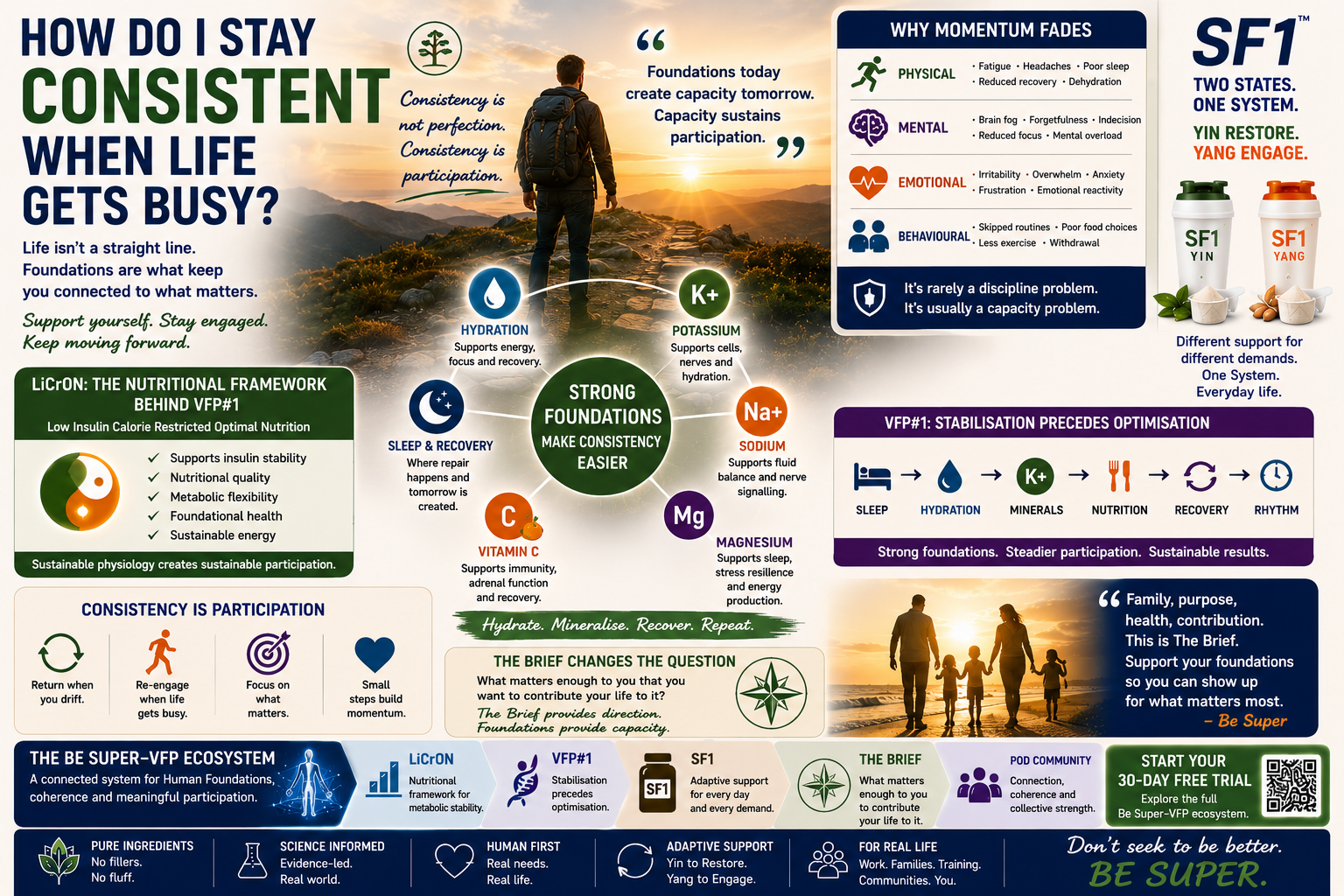
How Do I Stay Consistent When Life Gets Busy?
This is where many people stop trying to become better and begin learning how to support themselves properly.
Consistency Is Not A Discipline Problem
Most people think consistency is about motivation.
Or discipline.
Or willpower.
But if that were true, intelligent and committed people would never struggle.
Yet they do.
The reality is that consistency is often a capacity problem disguised as a discipline problem.
When foundations weaken:
- consistency weakens
- participation weakens
- momentum weakens
The issue is not usually character.
The issue is often support.
Life Is Not A Straight Line
Many people imagine consistency as:
Perfect days.
Perfect habits.
Perfect routines.
Perfect performance.
Real life rarely looks like that.
Life includes:
- work pressure
- family demands
- travel
- illness
- recovery
- stress
- opportunity
- uncertainty
Consistency is not about doing everything perfectly.
Consistency is about remaining connected to what matters despite changing circumstances.
Why People Lose Momentum
Most people do not suddenly stop.
They gradually lose capacity.
The warning signs often appear first as:
Physical
- fatigue
- headaches
- poor sleep
- reduced recovery
Mental
- brain fog
- forgetfulness
- indecision
- reduced focus
Emotional
- irritability
- overwhelm
- impatience
- frustration
Behavioural
- skipped routines
- poor food choices
- reduced exercise
- withdrawal from meaningful activities
The person often blames themselves.
The foundations are frequently telling a different story.
Human Foundations Influence Consistency
Everything becomes harder when foundations decline.
Hydration.
Recovery.
Sleep.
Nutrition.
Rhythm.
Relationships.
These are not optional extras.
They are the foundations upon which participation depends.
The stronger the foundations:
The easier consistency becomes.
Why Hydration Matters
Hydration influences:
- concentration
- energy
- recovery
- mood
- decision making
Many people become mildly dehydrated throughout the day without realising it.
Symptoms may include:
- headaches
- fatigue
- reduced focus
- lower physical performance
- poorer recovery
Hydration is not simply about water.
Hydration is about water and minerals working together.
Why Potassium Matters
Potassium contributes to:
- muscle function
- nervous-system function
- fluid balance
- cellular communication
One of the most important systems in human physiology is:
The Sodium-Potassium Pump
This mechanism helps regulate:
- hydration
- nerve signalling
- muscular function
- cellular communication
The body generally requires significantly more potassium than sodium.
When this relationship becomes less optimal, capacity often declines.
Why Sodium Matters
Sodium contributes to:
- hydration
- fluid regulation
- nerve signalling
- muscle contraction
Heat.
Sweat.
Travel.
Exercise.
Stress.
All influence sodium requirements.
The goal is not more sodium.
The goal is appropriate sodium.
This is why ratio matters.
Why Magnesium Matters
Magnesium contributes to:
- reduction of tiredness and fatigue
- nervous-system function
- energy metabolism
- psychological function
Low magnesium patterns are commonly associated with:
- fatigue
- tension
- poor sleep
- reduced resilience
Consistency becomes difficult when recovery becomes difficult.
Why Vitamin C Matters
Vitamin C contributes to:
- energy metabolism
- immune function
- collagen formation
- protection from oxidative stress
Periods of sustained demand often increase the importance of recovery and adaptation.
Vitamin C helps support both.
Why LiCrON Matters
LiCrON stands for Low Insulin Calorie Restricted Optimal Nutrition.
LiCrON emerged from a simple observation:
Many people attempt to improve performance while ignoring biology.
LiCrON focuses on:
- nutritional quality
- insulin stability
- metabolic flexibility
- foundational health
Because sustainable participation begins with sustainable physiology.
Why VFP#1 Matters
VFP#1 is the first stage of the wider Be Super-VFP framework.
Its core principle is:
Stabilisation Precedes Optimisation
Most people attempt optimisation first.
More effort.
More discipline.
More productivity.
VFP#1 begins elsewhere.
Hydration.
Minerals.
Sleep.
Nutrition.
Recovery.
Rhythm.
Because higher performance depends upon stronger foundations.
Why SF1 Exists
Most products support a category.
SF1 supports a person.
Life changes.
Requirements change.
Support should change too.
This is why SF1 exists as:
SF1 Yin — Restore
Supporting:
- everyday hydration
- recovery
- preparation
- regulation
SF1 Yang — Engage
Supporting:
- activity
- output
- heat
- sweat
One System.
Two States.
Different support for different demands.
Consistency Is Participation
Many people think consistency means:
Never missing a day.
Never making mistakes.
Never slowing down.
Real consistency is different.
Consistency means continuing to participate.
Returning when life becomes difficult.
Re-engaging when things drift.
Supporting yourself well enough to remain involved in what matters.
The Brief Changes The Question
Eventually consistency stops being about habits.
And starts being about purpose.
Because nobody remains consistent with something that means nothing to them.
This leads to a deeper question:
What matters enough to you that you want to contribute your life to it?
That question is The Brief.
The Brief provides direction.
Human Foundations provide capacity.
Together they support participation.
Don’t Seek To Be Better. Be Super.
Being Super is not perfection.
It is participation.
Not comparison.
Contribution.
Not optimisation.
Support.
Not becoming someone else.
Supporting who you already are.
Explore Further
Discover SF1
https://superfoods4u.co.uk/sf1-buy/
Explore Human Foundations
Explore The Brief
Begin Your Be Super-VFP 30-Day Free Trial
Explore:
- Human Foundations
- LiCrON
- VFP#1
- The Brief
- Sophia AI
- Feynman AI
- Weekly VFP Pulse
- Personal participation support
Because consistency is not about trying harder.
It is about supporting yourself better.