
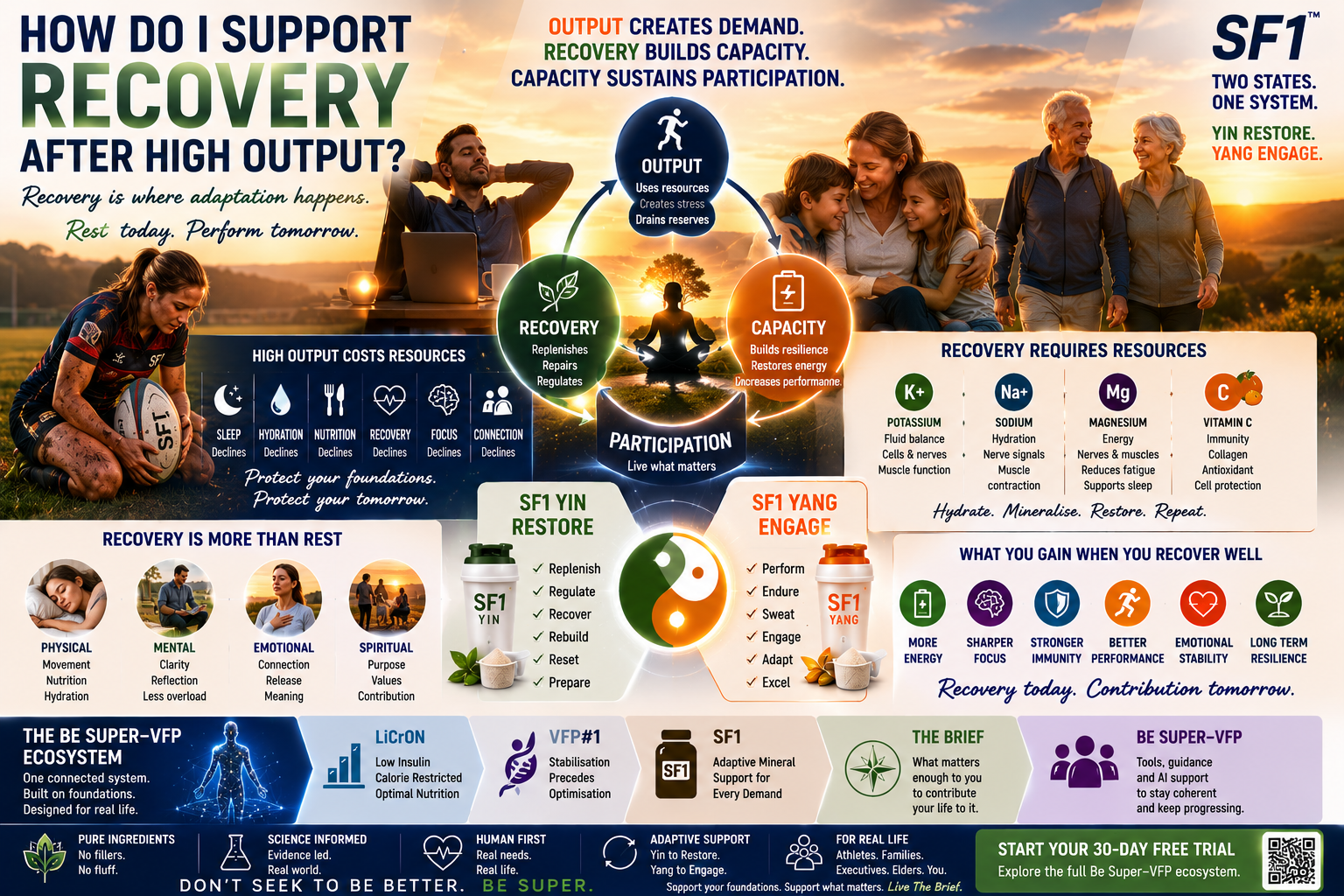
How Do I Support Recovery After High Output?
This article is powerful because almost everybody understands output.
Very few understand recovery.
Yet recovery is where adaptation occurs.
Recovery is where resilience is built.
Recovery is where tomorrow is created.
Output Is Only Half The Story
Modern culture often celebrates output.
Work harder.
Train harder.
Push harder.
Do more.
Yet every system in nature follows a rhythm.
Expansion and contraction.
Activity and rest.
Output and recovery.
Without recovery, output eventually becomes depletion.
Recovery Is Not Doing Nothing
Many people think recovery means inactivity.
Recovery is something different.
Recovery is the process through which the body restores capacity.
It is how we prepare for what comes next.
Without recovery:
- performance declines
- focus declines
- resilience declines
- participation declines
Recovery is not the opposite of progress.
Recovery enables progress.
What High Output Actually Costs
Every demanding day uses resources.
Physical resources.
Mental resources.
Emotional resources.
Biological resources.
High-output periods may influence:
- hydration
- mineral status
- sleep quality
- nervous-system load
- energy availability
This applies equally to:
- elite athletes
- busy executives
- parents
- carers
- students
- older adults
Output is not just physical.
Life itself creates demands.
Why Hydration Influences Recovery
The body cannot recover effectively without adequate hydration.
Hydration influences:
- nutrient transport
- cellular communication
- temperature regulation
- physical recovery
- cognitive function
Many people finish demanding days under-hydrated.
Then wonder why recovery feels incomplete.
Why Minerals Matter After Output
Recovery is not simply about resting.
Recovery requires resources.
Particularly:
Potassium
Sodium
Magnesium
These minerals support:
- hydration
- muscle function
- nerve signalling
- cellular communication
The greater the demand, the greater the importance of replenishment.
Why Potassium Matters
One of the most important biological systems is the:
Sodium-Potassium Pump
This mechanism helps regulate:
- hydration
- nerve function
- muscle function
- cellular activity
The body generally requires considerably more potassium than sodium.
After periods of exertion, maintaining this relationship becomes increasingly important.
This is why Potassium Gluconate forms part of SF1 architecture.
Why Magnesium Matters During Recovery
Magnesium contributes to:
- normal muscle function
- nervous-system function
- reduction of tiredness and fatigue
- psychological function
Many people think about recovery only after they feel exhausted.
The body is thinking about recovery every day.
Magnesium Taurate was selected because recovery is a foundational process, not an afterthought.
Why Vitamin C Matters
Recovery is an adaptive process.
Vitamin C contributes to:
- collagen formation
- immune-system function
- energy metabolism
- protection of cells from oxidative stress
SF1 uses Camu Camu because support should come from an integrated system rather than isolated ingredients.
Recovery Is More Than Physiology
Many people hear recovery and think:
Sleep.
Sleep matters enormously.
But recovery is broader.
Recovery also includes:
Physical Recovery
Movement.
Nutrition.
Hydration.
Mental Recovery
Clarity.
Reflection.
Reduced overload.
Emotional Recovery
Connection.
Relationships.
Meaning.
Purpose.
Human beings recover as whole systems.
What LiCrON Teaches About Recovery
LiCrON stands for Low Insulin Calorie Restricted Optimal Nutrition.
LiCrON recognises that adaptation requires resources.
Recovery is influenced by:
- nutrition quality
- metabolic flexibility
- insulin stability
- biological efficiency
The goal is not simply to survive demand.
The goal is to adapt to it.
Recovery is where adaptation happens.
What VFP#1 Teaches About Recovery
VFP#1 begins with a principle that becomes increasingly obvious under pressure:
Stabilisation precedes optimisation.
Many people attempt to optimise performance while neglecting recovery.
VFP#1 reverses the order.
Support:
- sleep
- hydration
- minerals
- nutrition
- recovery
first.
Performance becomes more sustainable when foundations are protected.
Why SF1 Uses Two States
A high-output day is not a recovery day.
The body does not have identical requirements in both states.
This is why SF1 exists as:
SF1 Yin — Restore
Supporting:
- replenishment
- regulation
- recovery
- preparation
SF1 Yang — Engage
Supporting:
- output
- activity
- sweat
- participation
One System.
Two States.
Different support for different demands.
Why Recovery Matters To The Brief
Most people do not recover for the sake of recovery.
They recover because something matters.
Their family.
Their work.
Their sport.
Their purpose.
Their contribution.
This is The Brief.
What matters enough to you that you want to contribute your life to it?
Recovery protects our ability to continue participating in what matters.
The Bigger Question
If recovery protects participation…
what happens when participation extends beyond ourselves?
How do we show up well for the people who matter most?
That leads naturally into the next section:
How Do I Show Up Better For My Family?
Explore Further
Buy or Explore SF1
SF1 Home
Human Foundations Knowledge Hub
Explore The Brief
Start Your 30-Day Free Trial
Don’t seek to be better.
Be Super.
Recover well.
Restore capacity.
Protect what matters.
Live The Brief.