
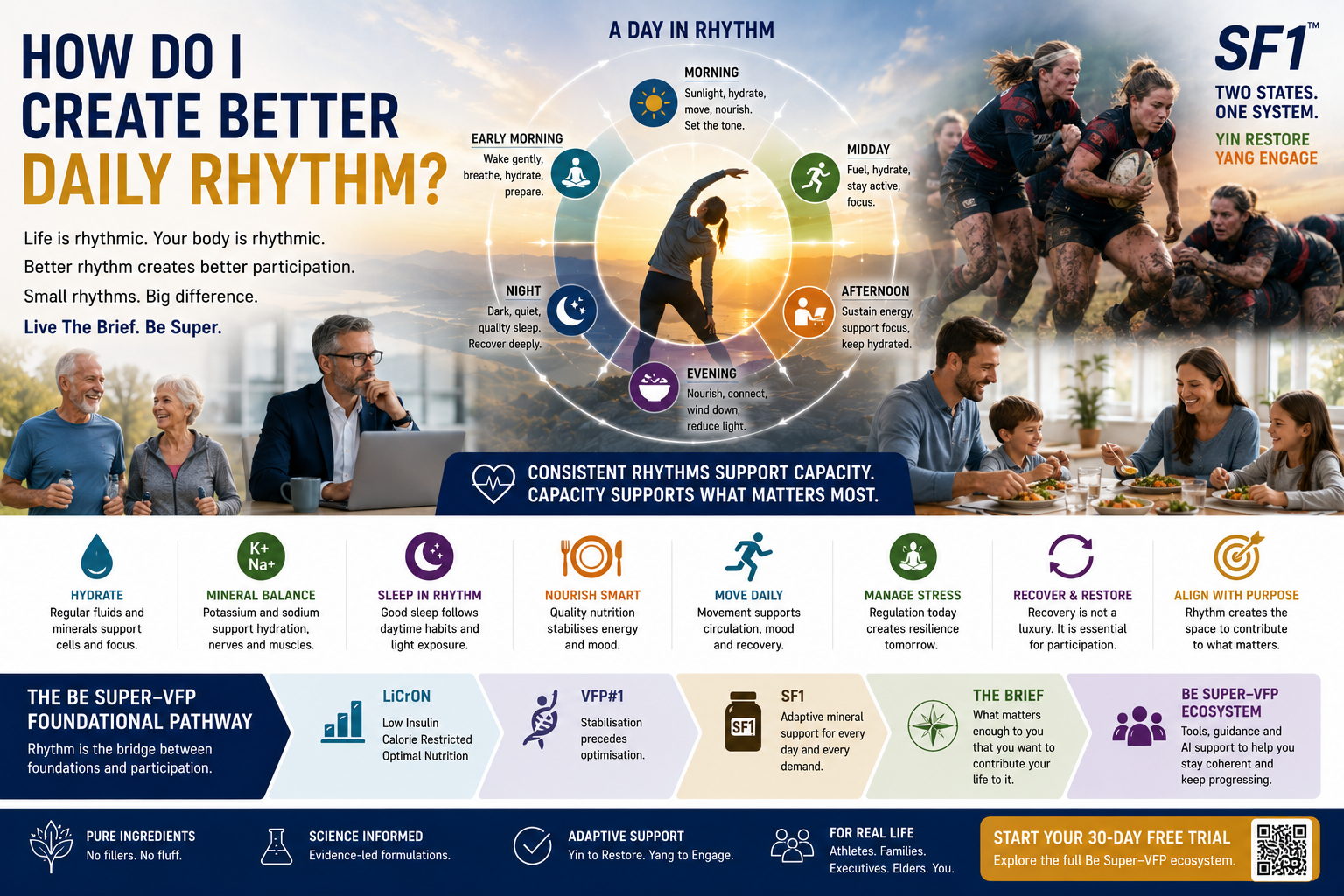
How Do I Create Better Daily Rhythm?
Life Is Rhythmic
Everything in nature moves through rhythms.
Day and night.
Activity and recovery.
Wakefulness and sleep.
Summer and winter.
Breathing in and breathing out.
The human body is no different.
Many of the systems that influence how we feel operate according to rhythms.
Energy.
Hormones.
Digestion.
Sleep.
Recovery.
Attention.
Mood.
When rhythm becomes disrupted, life often feels harder than it needs to be.
Why Rhythm Matters
Many people describe experiences such as:
- feeling tired but unable to sleep
- waking unrefreshed
- energy crashes
- inconsistent concentration
- irregular eating habits
- feeling “out of sync”
These experiences are often treated as separate problems.
Yet they may all be influenced by a common factor:
Rhythm.
The body generally functions best when important activities occur with some degree of consistency.
The Body Runs On Clocks
Humans possess internal biological clocks.
These clocks influence:
- sleep-wake cycles
- hormone production
- body temperature
- digestion
- recovery
- cognitive performance
Light is one of the strongest signals influencing these rhythms.
Morning daylight helps signal:
Wake up.
Darkness helps signal:
Prepare for sleep.
Modern life often disrupts these signals.
Artificial light.
Late-night screens.
Shift work.
Travel.
Stress.
Irregular schedules.
All can influence biological rhythm.
Why Sleep Is A Rhythm Question
Many people view sleep as a nighttime activity.
In reality sleep begins much earlier.
Sleep quality is influenced by:
- light exposure
- hydration
- nutrition
- stress
- recovery
- daily rhythm
Good sleep often starts during the morning.
Poor rhythm during the day frequently appears later as poor sleep.
Why Hydration Has A Rhythm
Hydration is not something that happens once per day.
It is a continual process.
Many people spend much of the day gradually becoming dehydrated before trying to compensate later.
A better approach is often:
- consistent fluid intake
- consistent mineral support
- responding to changing demands
especially during:
- heat
- travel
- exercise
- demanding work periods
Hydration works best as a rhythm rather than an emergency response.
Why Minerals Have A Rhythm
Mineral requirements are not fixed.
They change according to circumstances.
Training days are different from recovery days.
Travel days are different from home days.
Hot weather is different from cool weather.
This is one reason SF1 was developed as:
SF1 Yin — Restore
For everyday participation, recovery and preparation.
SF1 Yang — Engage
For sweat, heat, output and higher demands.
The body changes.
Support should change too.
What The Potassium-Sodium Relationship Teaches Us
One of the most important rhythms occurring constantly within the body is the movement of sodium and potassium across cell membranes.
This relationship supports:
- hydration
- nerve signalling
- muscle function
- cellular communication
The body generally requires more potassium than sodium.
However, sweating increases sodium loss.
This means requirements may change throughout the day and across different activities.
Understanding rhythm means recognising that needs are dynamic rather than fixed.
Why Magnesium Supports Rhythm
Magnesium contributes to:
- nervous-system function
- muscle function
- energy metabolism
- psychological function
- reduction of tiredness and fatigue
Many people associate magnesium with recovery.
But it also helps support regulation.
And regulation is fundamentally a rhythm process.
The body performs best when it can move smoothly between:
activity ↔ recovery
focus ↔ rest
output ↔ restoration
What LiCrON Teaches About Rhythm
LiCrON stands for Low Insulin Calorie Restricted Optimal Nutrition.
LiCrON recognises that rhythm matters nutritionally as well.
Many people move through cycles of:
- sugar spikes
- energy crashes
- cravings
- overeating
- fatigue
LiCrON seeks to support:
- insulin stability
- metabolic flexibility
- nutritional quality
- sustainable energy
The goal is not simply eating differently.
The goal is creating a more stable biological rhythm.
What VFP#1 Teaches About Rhythm
VFP#1 begins with a simple observation:
Life becomes easier when foundations become more stable.
This does not require perfection.
It requires rhythm.
Consistent sleep.
Consistent hydration.
Consistent recovery.
Consistent nourishment.
Consistent participation.
Small rhythms often create large outcomes over time.
Why SF1 Exists
Most products focus on a single moment.
Energy now.
Recovery now.
Performance now.
SF1 was designed to support participation across changing demands.
Work.
Study.
Travel.
Training.
Recovery.
Family life.
The goal is not simply to feel better today.
The goal is to support sustainable participation over time.
Why Rhythm Matters To The Brief
Most people do not want rhythm for its own sake.
They want rhythm because something matters.
A family.
A responsibility.
A goal.
A purpose.
A contribution.
This is The Brief.
The Brief is simply:
What matters enough to you that you want to contribute your life to it?
The challenge is not usually discovering what matters.
The challenge is creating the capacity to continue showing up for it.
Rhythm helps create that capacity.
The Bigger Question
If rhythm influences participation…
and participation influences contribution…
how do we support ourselves when life becomes demanding, chaotic or unpredictable?
That question leads naturally to:
How Do I Support Training And Exercise?
because training is one of the clearest examples of changing human demand.
Explore Further
Buy or Explore SF1
https://superfoods4u.co.uk/sf1-buy/
SF1 Home
Human Foundations Knowledge Hub
https://superfoods4u.co.uk/explore-sf1-knowledge-hub/
Explore The Brief
Start Your Be Super-VFP Free Trial
Don’t seek to be better.
Be Super.
Support your rhythm.
Support your foundations.
Support what matters.
Live The Brief.