
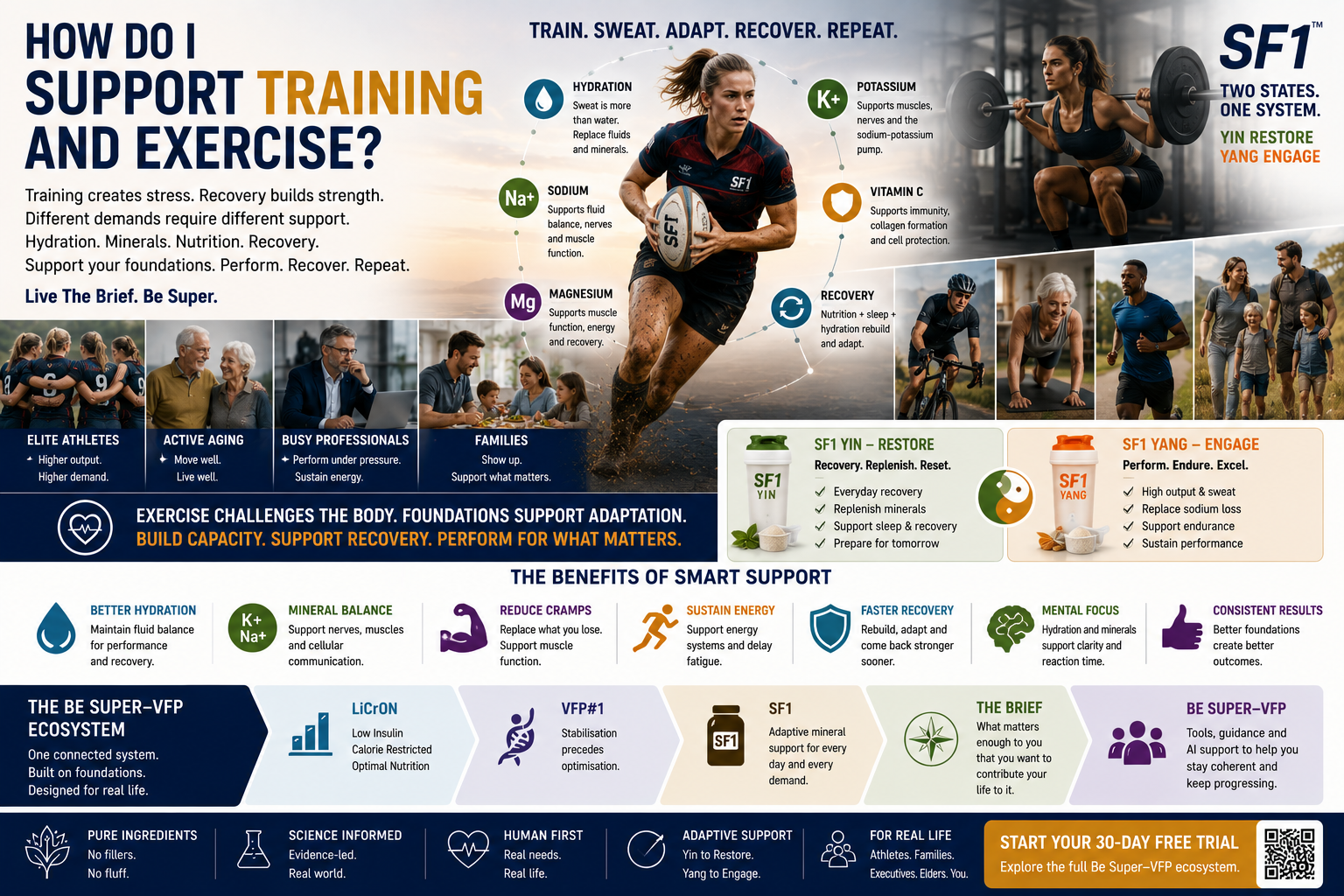
How Do I Support Training And Exercise?
Training Is A Stress
Most people think of training as something that makes us stronger.
That is true.
But only after recovery occurs.
Training itself is a form of stress.
Running.
Cycling.
Gym work.
Team sports.
Swimming.
Rugby.
Tennis.
Martial arts.
All create demands on the body.
The body then adapts during recovery.
Without recovery there is no adaptation.
Without support there is no recovery.
Exercise Changes Human Requirements
A common mistake is assuming that the body needs the same support every day.
It doesn’t.
Training changes requirements.
Exercise influences:
- hydration
- mineral balance
- energy use
- recovery requirements
- sweat loss
- muscle function
This is one reason LiCrON and VFP#1 recognise that support must adapt to changing demands.
Sweat Is More Than Water Loss
Many people replace water.
Fewer replace what leaves with the water.
Sweat contains:
Sodium
Potassium
Magnesium
and other minerals.
The more we sweat:
- the more fluid we lose
- the more minerals we lose
- the greater the importance of replacement
This becomes particularly relevant during:
- training
- hot weather
- endurance exercise
- physically demanding work
Why Sodium Matters During Exercise
Sodium helps regulate:
- fluid balance
- nerve function
- muscle contraction
Low sodium patterns may contribute to:
- headaches
- fatigue
- dizziness
- reduced performance
- muscle cramping
Because sodium is lost through sweat, replacement becomes increasingly important during higher-output activity.
This is why SF1 Yang contains significantly more Himalayan Rock Salt than SF1 Yin.
Not because Yang is “stronger.”
Because exercise creates different demands.
Why Potassium Matters
The human body generally requires considerably more potassium than sodium.
Potassium contributes to:
- muscle function
- nervous-system function
- fluid balance
- cellular communication
One of the most important systems in human physiology is the sodium-potassium pump.
This mechanism supports:
- nerve signalling
- muscle contraction
- hydration
- cellular communication
When training volume increases, maintaining this relationship becomes increasingly important.
This is why Potassium Gluconate forms a central part of SF1 architecture.
Why Magnesium Matters During Training
Magnesium contributes to:
- normal muscle function
- energy metabolism
- reduction of tiredness and fatigue
- nervous-system function
Many athletes focus on protein.
Many overlook minerals.
Yet muscles cannot function optimally without them.
Magnesium Taurate was selected because SF1 was designed around foundational support rather than ingredient fashion.
Why Vitamin C Matters
Exercise creates physiological demand.
Vitamin C contributes to:
- immune-system function
- collagen formation
- protection of cells from oxidative stress
- normal energy-yielding metabolism
SF1 uses Camu Camu as a natural whole-food source of Vitamin C.
Because the form matters.
The ratio matters.
The system matters.
Training Is Not Just For Athletes
Many people hear the word “training” and think:
Elite sport.
But training includes:
- walking
- gardening
- yoga
- swimming
- gym sessions
- active ageing
- family activities
- recreational sport
Human movement exists on a spectrum.
The principles remain the same.
The body adapts to demand.
Support helps adaptation.
What LiCrON Teaches About Exercise
LiCrON stands for Low Insulin Calorie Restricted Optimal Nutrition.
LiCrON recognises that energy management matters.
Training places demands on:
- metabolism
- recovery
- nutrient utilisation
- adaptation
LiCrON focuses on supporting:
- insulin stability
- nutritional quality
- metabolic flexibility
The goal is not simply more energy.
The goal is more effective energy use.
What VFP#1 Teaches About Exercise
VFP#1 begins with Human Foundations.
Before performance comes:
- sleep
- hydration
- minerals
- recovery
- nutrition
Many people try to optimise training while neglecting the foundations that support adaptation.
VFP#1 teaches:
Stabilisation precedes optimisation.
This applies to exercise just as much as any other area of life.
Why SF1 Uses Two States
A recovery day is not a training day.
A study day is not a rugby match.
A cool office is not a hot summer run.
This is why SF1 exists as:
SF1 Yin — Restore
Supporting:
- recovery
- replenishment
- regulation
- preparation
SF1 Yang — Engage
Supporting:
- output
- endurance
- sweat
- participation
One System.
Two States.
Different support for different demands.
Why Training Matters To The Brief
Most people do not train simply to exercise.
They train because something matters.
Health.
Longevity.
Performance.
Confidence.
Capability.
Family.
Life.
Training is often one way of preparing ourselves to participate more fully in what matters.
This is The Brief.
What matters enough to you that you want to contribute your life to it?
The stronger the foundations, the greater the capacity for participation.
The Bigger Question
If exercise changes mineral requirements…
and sweat changes hydration requirements…
what happens when environmental conditions change too?
That leads naturally to:
How Do I Handle Heat Better?
Explore Further
Buy or Explore SF1
https://superfoods4u.co.uk/sf1-buy/
SF1 Home
Human Foundations Knowledge Hub
https://superfoods4u.co.uk/explore-sf1-knowledge-hub/
Explore The Brief
Start Your Be Super-VFP Free Trial
Don’t seek to be better.
Be Super.
Support your foundations.
Support your training.
Support what matters.
Live The Brief.